Overview
Buzz was the first filmed Rustle Experience: a roughly 90-minute experience for two people who had never met.
One participant, Hair, knew before arriving that she was willing to have her head shaved. The other, Cutter, did not know that haircutting was part of the experience. Neither knew how the night would unfold.
They met at a closed bar, spent time together without exchanging real names, chose nicknames for each other, watched the lock of a closed boutique get picked, explored the store in the dark, selected prizes, and were later blindfolded and driven to a final location.
At Tradesmen Barbershop, Cutter found Hair already prepared in the chair. An envelope asked:
Will you shave this stranger’s head?
The design problem was not the haircut itself. It was how to make that question matter after only 90 minutes.
Core design
Buzz was built around two things happening at once: the participants needed to become less anonymous to each other while the experience became less predictable.
The first track was connection. Buzz gave them time together before asking much of them. They talked, chose nicknames, moved through unfamiliar situations together, and accumulated some shared history.
The second was uncertainty. Buzz did not hide everything at once. It removed certainty in stages: real names, the purpose of a location, the reason for an activity, then the location itself and the nature of the final task.
The next action was usually clear even when the purpose was not.
That distinction allowed the participants to keep moving without needing to understand the entire plan.
How the experience unfolded
Buzz began at Pour Decisions. The business was closed for the experience, leaving the participants together without a normal crowd around them.
They were told they were being filmed and listened to, that they should follow the instructions they received, that they could not share their real names, and that either person could pause the experience by saying the safe word Oklahoma.
After they had time to talk, each participant chose a nickname for the other. Those names, Pinkie and Rainbow, were used for the rest of the night. The mechanic created a shared reference that belonged only to them.
The second location was The Whimsy Artisan Boutique in the Houston Heights.
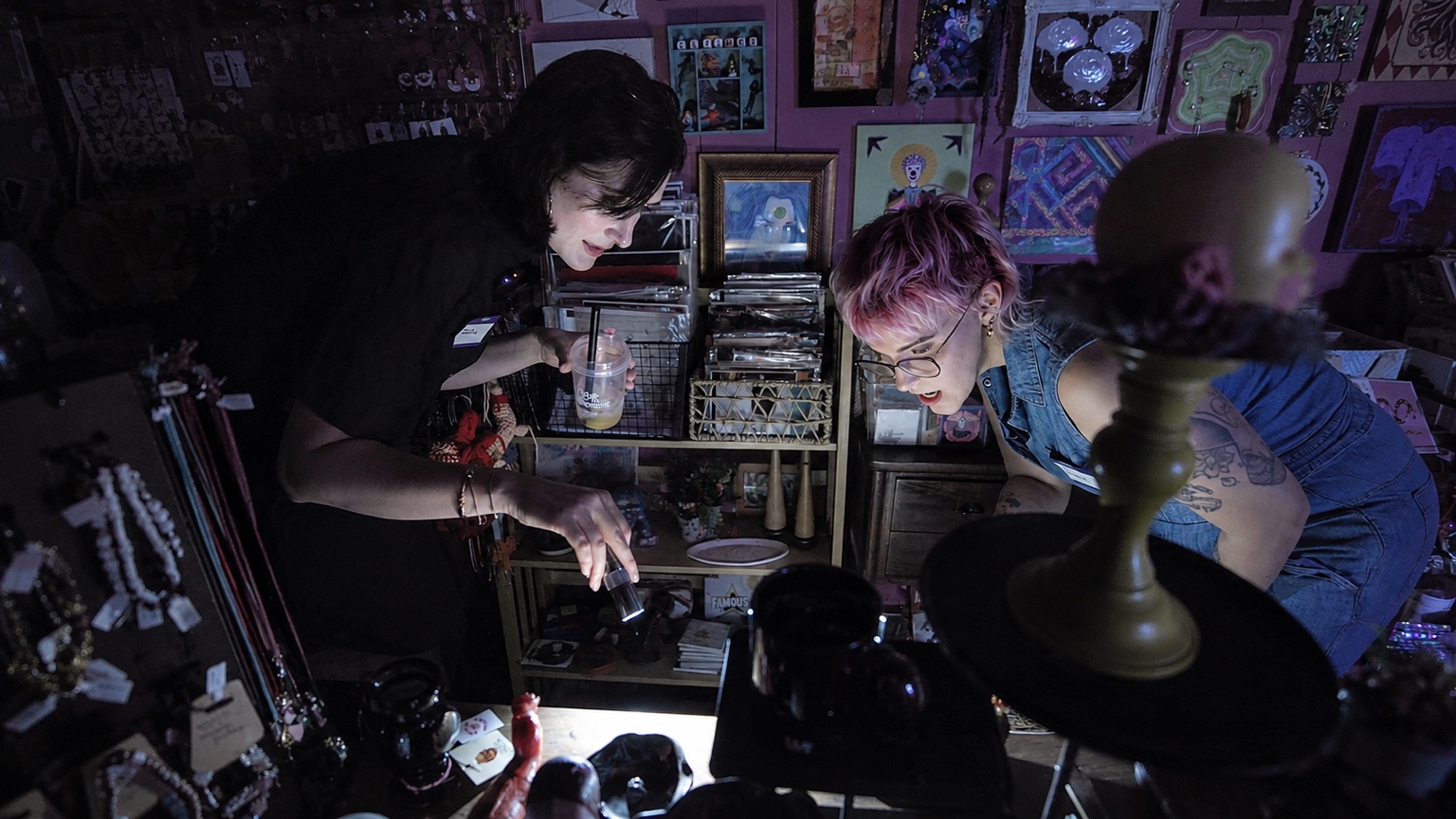
The participants were told to go inside and discovered that the door was locked. They were asked to watch the street while the host picked the lock. The business had approved the sequence in advance; the uncertainty belonged to the participants, not the production.
Inside, each participant received a flashlight and was told to look around until they thought they had seen everything. No objective was given.
After exploring together, they were separated and returned one at a time. An envelope instructed each person to choose one object as a prize and “don’t forget to check out.”
A sign on a closed door said:
KNOCK TO CHECKOUT
When the participant knocked, the door opened only far enough for an arm to appear. The object was taken, wrapped out of sight, and returned. The person behind the door never appeared or explained the process.
After Whimsy, both participants were blindfolded and driven to Tradesmen Barbershop.
Why the sequence mattered
Each location had a different job.
Pour Decisions established a normal social baseline. The participants had time to talk before the experience began asking them to do unusual things.
Whimsy changed the rules. The locked door, flashlight exploration, individual prize selection, and checkout interaction all gave the participants clear things to do without explaining where any of it was leading.
Tradesmen worked differently. It was a location whose purpose could be understood almost immediately once Cutter entered it.
The sequence also changed what information was missing.
Early in the night, the participants mostly knew where they were but not why they were doing something. The blindfold removed location as well. By the final act, Cutter knew neither where she was nor what she was preparing to do.
Hair entered Tradesmen first and was prepared in the barber chair. Because she had already consented to the haircut, her remaining uncertainty was how the final part of the experience would work.
Cutter arrived separately and waited in a back room while still blindfolded.
For about three minutes, she was asked to think about where she might be and where she hoped she was not.
Earlier uncertainty had usually come with an activity. Here, there was nothing to solve.
She then removed the blindfold and was told to wash her hands up to the elbow, put on nitrile gloves, and come through the door to find out where she was.
Those instructions suggested a physical task without revealing it.
The decision
When Cutter entered the barbershop, most of the remaining information became visible at once.
Hair was in the chair. A professional barber was beside her. An envelope was waiting.
The envelope asked:
Will you shave this stranger’s head?
The barber turned on the clippers and offered them to Cutter.
That moment changed the rule of the experience.
Until then, Buzz had mostly given instructions: choose a nickname, watch the street, explore the store, choose a prize, put on a blindfold, wash your hands, put on gloves, open the envelope.
The final line was not an instruction. It was a question.
Buzz could construct the situation, control the timing, and decide what information arrived when. It could not decide what Cutter should do once she understood the request.
The experience stopped directing at the point where the participant’s choice became the content.
The word stranger also mattered.
Hair and Cutter had met only that night, but they had spent the previous 90 minutes talking, naming each other, and navigating unusual situations together.
The question arrived after “stranger” had become less straightforward than it was at the beginning.
Safety and consent
The uncertainty in Buzz was designed. The boundaries were established in advance.
Hair explicitly consented to having her hair cut before participating, although she did not know the exact sequence or who might be asked to perform the cut.
Cutter was not told that haircutting was part of the experience, but the final decision remained hers.
Both participants were given the safe word Oklahoma, which paused the experience.
A professional barber was present for the haircut sequence, and the participating businesses knew what had been planned in their spaces.
Participants and businesses completed the required filming and appearance releases.
What Buzz established
Buzz showed that a meaningful outcome did not require a complicated plot.
The structure was simple: give two strangers time together, change the rules gradually, keep the immediate instructions understandable, and save the real choice for the end.
It also showed the value of real locations. Pour Decisions, Whimsy, and Tradesmen were not neutral backdrops. Each business performed a specific function without needing to become an elaborate set.
Most importantly, Buzz established a boundary for how Rustle handles agency:
The experience can design the route to a decision. Once the decision is real, it has to belong to the participant.